EL SINTHOME ES SUFRIR POR TENER UN ALMA [*]
Bien, comencemos por situar lo que en el comienzo de un análisis llamamos el padeciente, es decir la construcción de la posición del sufriente, del que consulta por su dolor o padecimiento específico. Unos días antes de dictar el Seminario 23, El sinthome, en las “Conclusiones de las Jornadas de estudio de la EFP” del 9-11-75, Lacan habla de “sufrir por tener un alma” y lo dice así: “no es inoportuno querer hablar de [la psicopatía] […] bajo el nombre de sinthome […] el sinthome es sufrir por tener un alma”.
PSICOPATÍA
En el diccionario etimológico vemos psicopatía y su definición: la palabra «psicopatía» está formada con raíces griegas y significa «el que tiene un padecer mental». Sus componentes léxicos son: psykhe (alma, actividad mental) y pathos (emoción, sentimiento, sufrimiento). Curiosamente, esta expresión que utiliza aquí Lacan “sufrir por tener un alma”, que remite a Santo Tomás y a la cuestión de lo que está adentro de cada uno, es decir lo individual y lo autónomo y luego la relación con Dios, con el todo, Lacan la pone en relación con el sufrir. Esto está bien desarrollado en el trabajo sobre nudos que realiza Félix Morales (1) y me parece pertinente para ubicar este primer momento en la dirección de la cura, es decir tenemos el padeciente, si así se lo construye, y el encuentro con un posible analista, si es que se puede pasar a la segunda fase. Esta segunda fase concierne al pasaje justamente de ‘padeciente’ a ‘analizante’ y de ‘posible analista’ a ‘analista’. Esta fase se caracterizaría por la posibilidad de la construcción del fantasma: S barrado, rombo o deseo de “a” ($<>a), todo entre paréntesis, lo que connota unidad, los paréntesis connotan unidad del fantasma.
FANTASMA NEURÓTICO Y PULSIÓN
En este punto debemos también aclarar que antes de poder construir el fantasma, lo que implica la relación del sujeto al objeto del deseo, lo que encontramos en la neurosis no es la relación del sujeto al objeto del deseo, sino la relación del sujeto a la demanda del Otro. Podemos así indicar que este pasaje del sujeto en relación a la Demanda, al sujeto en relación al objeto del deseo, lo llamamos desneurotización del fantasma, ya que la neurosis se caracteriza por ubicar la demanda (del Otro) en el lugar del objeto del deseo, siendo así, que la neurotización del fantasma puede escribirse de la siguiente manera entonces: sujeto barrado, rombo o deseo de D ($<>D), todo entre paréntesis también. Nótese que, si bien se leen de forma diferente, esta fórmula se escribe igual que la de la pulsión: ($<>D). En el caso de la pulsión, el sujeto barrado se lee como “localización del sujeto del inconsciente en el inconsciente”, ya que el sujeto tiene dos localizaciones, esta y la de estar entre significantes, efecto del significante; y la D puede leerse, como “el tesoro de los significantes” en la diacronía, tal y como figura arriba a la derecha sobre la cadena de la enunciación del grafo del deseo (ver grafo del deseo).
NEUROTIZACIÓN DEL FANTASMA ($<>D)
Ahora bien, entonces en la fórmula de la neurosis o neurotización del fantasma, la S barrada debe leerse como el lugar donde se localiza el hablanteser que porta la falla del Otro, y la D mayúscula, como la demanda del Otro, posicionada como objeto del deseo (falso objeto del deseo, claro), más bien podríamos decir, como aclara Alfredo (2), que más que un sujeto barrado, en esta posición de la neurosis de transferencia, se trata de un ‘yo barrado’ o ‘yo tachado’, que indica que se ha desplazado la falla del Otro hacia el yo, por la que este se encuentra en posición de minusvalía por ejemplo, impotencia, etc., en la que justamente carga sobre sí con la falla del Otro, velándola. En Lacan, lo importante es que la castración que el neurótico vela a través de ubicar la demanda en el lugar del objeto del deseo es la falla del Otro, en su doble vertiente, Otro encarnado y A/ (A barrado u Otro estructural). De este modo, vamos a coincidir con Alfredo en llamar cura de la neurosis a la efectivización de este pasaje, del fantasma neurótico al fantasma como tal […].
____________________________
*Fragmento de mi presentación en APOLa (Apertura Para Otro Lacan) México-Morelia, el 18-5-20, como ‘Preguntas en torno a la dirección de la cura’ (Actividad interna)
Ref.: 1. Félix Morales, Anudarse á la Lacan». Letra Viva.
- Alfredo Eidelsztein, “Las estructuras clínicas a partir de Lacan volumen II”.
-Jacques Lacan, Nota italiana de 1973, conocida también como Nota a los italianos, en “Otros Escritos”, ed. Paidós.

¿NARCISISMO, FUENTE DE AMOR Y ESCLAVITUD? O ¿ALIENACIÓN, RIVALIDAD Y DOMINIO? [*]
«Representémonos al yo como una red de neuronas bien investidas…» (1)
Dos concepciones teóricas distintas con respecto al Yo se definen en esta oposición: Por un lado, el Yo de ‘Introducción del narcisismo’ (Freud, 1914 ), como objeto de amor, unificante de las llamadas pulsiones autoeróticas, y esclavo de las tiranías de la realidad, el Ello y el Superyó, por el otro un Yo en posición de dominio, alienado (Alienación imaginaria: El ‘yo es otro’, finalmente una suma de identificaciones), sujeto a la rivalidad imaginaria: ‘el otro o yo’ o lucha de puro prestigio, más que fuente de amor.
UN AMOR NARCISISTA
El amor yoico en Freud sería entonces un amor narcisista, en tanto ama al otro como a sí mismo. Lacan plantea lo contrario, es decir una relación con el otro (en este plano imaginario), en rivalidad y tensión,ya que en el estadío del espejo es el otro el que aparece completo, con todos los atributos y el yo en posición despedazada, castrado con respecto a la completud de la imagen. De esta manera en Lacan, no serían superponibles el estadio del espejo y el narcisismo.
LOS DOS YOES EN FREUD
A la vez, debemos distinguir dos Yoes en Freud: el yo de 1895 («Proyecto de ‘una psicología para neurólogos»), en tanto lo presenta allí como una red de neuronas bien investidas’ o ‘grafo’..Lacan aprecia este modelo en el sentido de un planteo en red, tal como se presenta en su trabajo con los significantes como redes de significantes, lo que se verifica en el esquema del grafo del deseo.
LA INTRODUCCIÓN DEL NARCISISMO
Por otra parte, tenemos el Yo de la Introducción del narcisismo de 1914, que es el que venimos trabajando como ‘un nuevo acto psíquico’, tal como lo dice Freud, allí donde el yo se ofrece como objeto de amor de las pulsiones, que luego tendrá en los ‘objetos’ del mundo sus representantes. En este caso tendremos un amor básicamente narcisista.
DAR LO QUE NO SE TIENE
El amor en Lacan aparece ligado a la falta, y no al tener, resaltado en su famosa frase ‘Dar lo que no se tiene…» que tiene su origen en la teoría del Don de Marcel Mauss. Como último detalle recordemos aquí que Freud trabaja con objetos tridimensionales, como el cuerpo 3D, del que partirían las pulsiones, etc. La reescritura del psicoanálisis por parte de Lacan se realiza en la dimensión 2D. Así sus concepciones: objeto a, significante de la falta del Otro, sujeto, Ideal del Otro, significado del Otro, el deseo es el deseo del Otro, el inconsciente como Discurso del Otro, etc, pertenecen al espacio bidimensional.
EL HUEVO O EL TORO
En el centro del huevo freudiano (Yo, superyó, ello) se encuentra el Yo, en ese exacto lugar Lacan ubica un agujero, convirtiéndolo en la figura topológica del Toro.
________________
*Apuntes de lectura sobre el libro de Alfredo Eidelsztein «No hay sustancia corporal».
- «Proyecto de una psicología para neurólogos».

¿EXISTE EL DESEO DE MUERTE? [*]
Hay un interesante debate proveniente de una cita de Lacan, donde parece decir de la existencia de un deseo de muerte como tal, estructural, que conectaría fácilmente, desde alguna lectura, con la llamada por Freud, pulsión de muerte, que avalaría incluso una tendencia suicida originaria.
LO QUE ESTABA ANTES
Veamos la cita en cuestión, es de «Función y campo del habla y del lenguaje», Escritos 1. Dice así:
«Por eso cuando queremos alcanzar en el sujeto lo que estaba antes del juego serial de la palabra [Fort-da, u otras] y aquello que es primordial al nacimiento de los símbolos, nosotros lo encontramos en la muerte de dónde su existencia toma todo aquello que tiene sentido. Es como deseo de muerte en efecto que él se afirma para los otros; si él se identifica al otro lo es coagulándolo en la metamorfosis de su imagen esencial y todo ser allí no es evocado más que entre las sombras de la muerte». (1)
ANTES DE LA PRIMERA REPETICIÓN
Recordemos en principio que aún Lacan no tenía conceptualizado al Otro en esta época (lo introduce formalmente en el seminario 2). Lacan se pregunta sobre el estatuto del sujeto antes de la primera repetición, antes de la repetición del primer par de significantes (S1/S2). Así entonces, este ‘deseo de muerte’ es en relación al otro imaginario del estadio del espejo, es deseo de muerte del otro, en el marco de la agresividad imaginaria con ese otro.
EL DESEO DE MUERTE DEL otro
El punto es que ese otro de la agresividad imaginaria especular, es uno mismo, debido a la identificación al otro (alienación imaginaria), por lo que termina siendo suicida, ya que el otro es también uno mismo. Por lo tanto, no es deseo de muerte como tal, del sujeto mismo, es el deseo de muerte del otro a partir de la tensión agresiva a-a’ especular. El ejemplo de Narciso nos clarifica.
________________________
*Apuntes de lectura sobre: *»Complejo de Edipo y metáfora paterna», A. Eidelsztein, 1998.
- Función y campo.. Pág. 307.
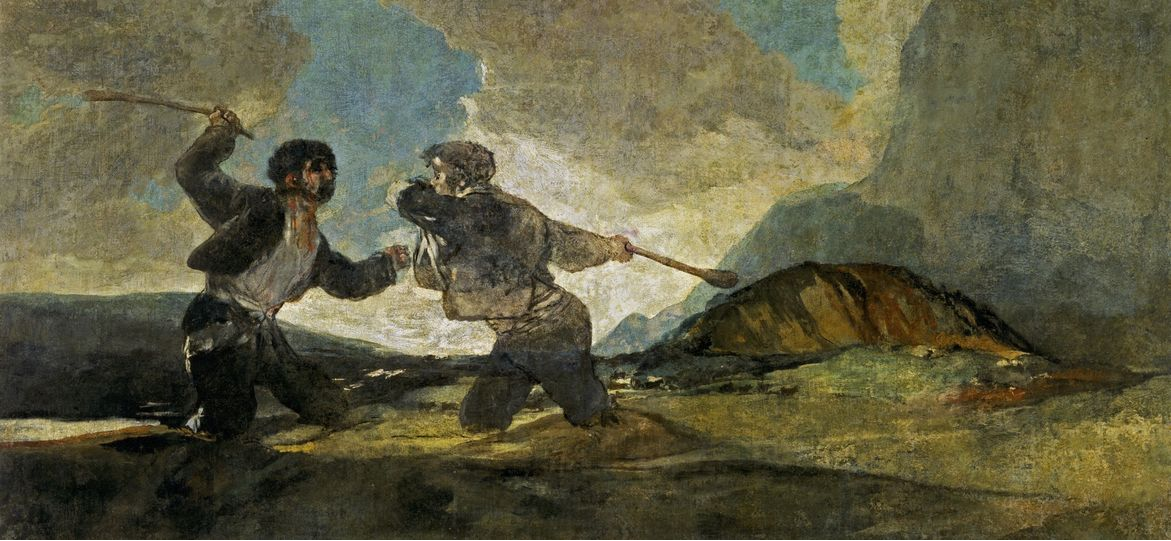
Imagen: «Duelo a garrotazos o la riña», Francisco de Goya.
EL DISCURSO DEL ODIO
«Cada ser humano en particular queda de hecho atado, queda atado por cuanto vive en constante interdependencia funcional con otras personas, es un eslabón de la cadena que ata a otras personas, y cada una de estas otras personas es -directa o indirectamente- un eslabón de la cadena que lo ata a él. Estas cadenas no son tan visibles y palpables como las cadenas de hierro; son más elásticas, variables y alterables, pero no son menos reales y, con toda certeza menos firmes…» Norbert Elias (1)
LA DESTRUCCIÓN DEL OTRO
El discurso de odio es hermano del racismo y de la destrucción del otro/Otro. Pretende fundar sus raíces en el cuerpo biológico (pulsiones orgánicas), resalta el individualismo y conduce al nihilismo. Desea el exterminio de la diferencia, la supresión de la división del sujeto y la consolidación del yo («yo soy yo, vos sos vos»).
LOCURA
Una porción de locura desatada que puentea el lazo social (definimos así a la locura), que impone la ley del corazón (Hegel): «mi ley es la que vale por sobre la de cualquier otro», y se asienta en la posición del Alma Bella: «yo no tengo nada que ver con lo que me sucede y de lo cual me quejo» [sin que esto implique, para nuestro psicoanálisis habilitar el tema de la responsabilidad subjetiva, propia del ámbito jurídico, pero no del sujeto dividido].
NO SE TRATA DE PULSIÓN DE MUERTE
No se trata para nosotros de ninguna pulsión de muerte o sus derivados, ya que allí nuevamente fundaríamos su razón en el cuerpo orgánico, en un ser biológico supuestamente ‘natural’, manantial de las pulsiones, ese aspecto irracional presente en Hobbes o en las masas de Le Bon, que hay que controlar o acotar para que no corrompa la supuesta moral individual del sujeto .
UN TEMA CULTURAL
Lejos de ello, es un tema cultural, cuya primacía está en el lenguaje y en las consecuencias del juego significante en la maquinaria estructural del sujeto. Nuestra cultura desprecia el «entrelazamiento de las personas» (al decir de Norbert Elías), la immixión de los sujetos (Immixion de Otredad), y acentúa el valor de lo «propio», lo individual-singular (único e irrepetible) por encima de lo particular (que, como los dedos a la mano, son «partes» del Otro).
EL ODIO ES RACISTA (2)
El odio es racista, servidor de un discurso amo transformado en capitalista, rechazante de la castración y del amor. No podríamos decir que ‘alguien’ es el autor de este estado de cosas, sino que Eso habla en nosotros efecto de una época. Esto no implica abandonar un trabajo de fuerza contraria (al sentido común), lo que implica una ardua tarea deconstructiva de prejuicios y de todos los elementos considerados ‘naturales’, universales y eternos.
________________________________
1.»La sociedad de los individuos: ensayos, Barcelona, Península, 1990.
- Nota: ‘EL ODIO ES RACISTA’, cuando se lo extrae de una cadena donde ningún significante es nada en sí mismo sino que necesita de otros para significar algo. Es lo que sucede cuando se eleva cualquier significante al valor de Ideal del Yo (Ideal del Otro, en Lacan).
Imagen: «La guerra de voluntarios», Bernhard Heising.

EL CALDO ESTÁ SERVIDO [*]
«Es habitual el empleo de términos como ‘individuo’ y ‘sociedad’, el primero de los cuales remite al ser humano particular , como si este fuese un ser que existe aislado, en sí mismo…» Norbert Elias (1)
A PARTIR DEL OTRO
Creo que el análisis podríamos hacerlo desde el contexto, a partir del Otro, no del individuo, que es justamente el eje del que parten Freud y Le Bon, con teorías fuertemente individualistas. Allí la masa es un descomponedor del individuo… Cómo si este tuviese una esencia moral diluible en la masa. Lacan encuentra mejores salidas acorde a su enseñanza: por ej. Que no hay sujeto sin Otro y ofreciéndonos (ya desde el sueño de inyección de Irma, y más tarde la precisión de la Immixión de Otredad, en la Conferencia de Baltimore, en 1966)…. Indicando que al sujeto se entra desde el Otro. La caracterización del Otro es central entonces.
EL GOCE NO ES INDEPENDIENTE DEL SIGNIFICANTE
En nuestra cultura occidental (patriarcal y judeocristiana), que se presenta como individualista, sustancialista, biologicista y de tiempo presente… (Característico del neoliberalismo y el posmodernismo)… Debe ser analizado. El goce no es independiente del significante, es su efecto, por lo tanto analizable, dialectizable y castrable (Miller lo ubicaría como no dialectizable y no castrable). Hay mejores autores que Le Bon para salir del Individualismo freudiano… Marcel Mauss,(1872-1950) por ejemplo, citado por Lacan en diversas oportunidades (teoría del Don, el potlatch, etc.)… O Norbert Elias (1897-1990), con su concepto de ‘entrelazamiento‘ para la sociedad de individuos… *Algunos de ellos contemporáneos a Freud, por otra parte.
EL SUJETO ES PARTE DEL OTRO
No es casual la inclinación freudiana por estás teorías (Le Bon, Schopenhauer, afines a posturas individualistas). El sujeto (no el individuo), es parte del Otro, es particular, no singular (de singularis, voz latina), único en su tipo o especie, infrecuente, anómalo, sorprendente… (Solo en la psicosis en relación a las suplencias por ausencia de metáfora paterna, lo singular se presenta), lo que se opone a la propiedad de «Immixion», postulada por Lacan: no hay sujeto sin Otro (hay distintas posiciones sobre todo esto claro)… El caldo para la ultraderecha está servido.
Jjs.
_________________________
*[Comentario a propósito del escrito «Vociferación», de Graciela Brodsky.
- «La sociedad de los individuos» (reúne artículos de 1939-50-87)
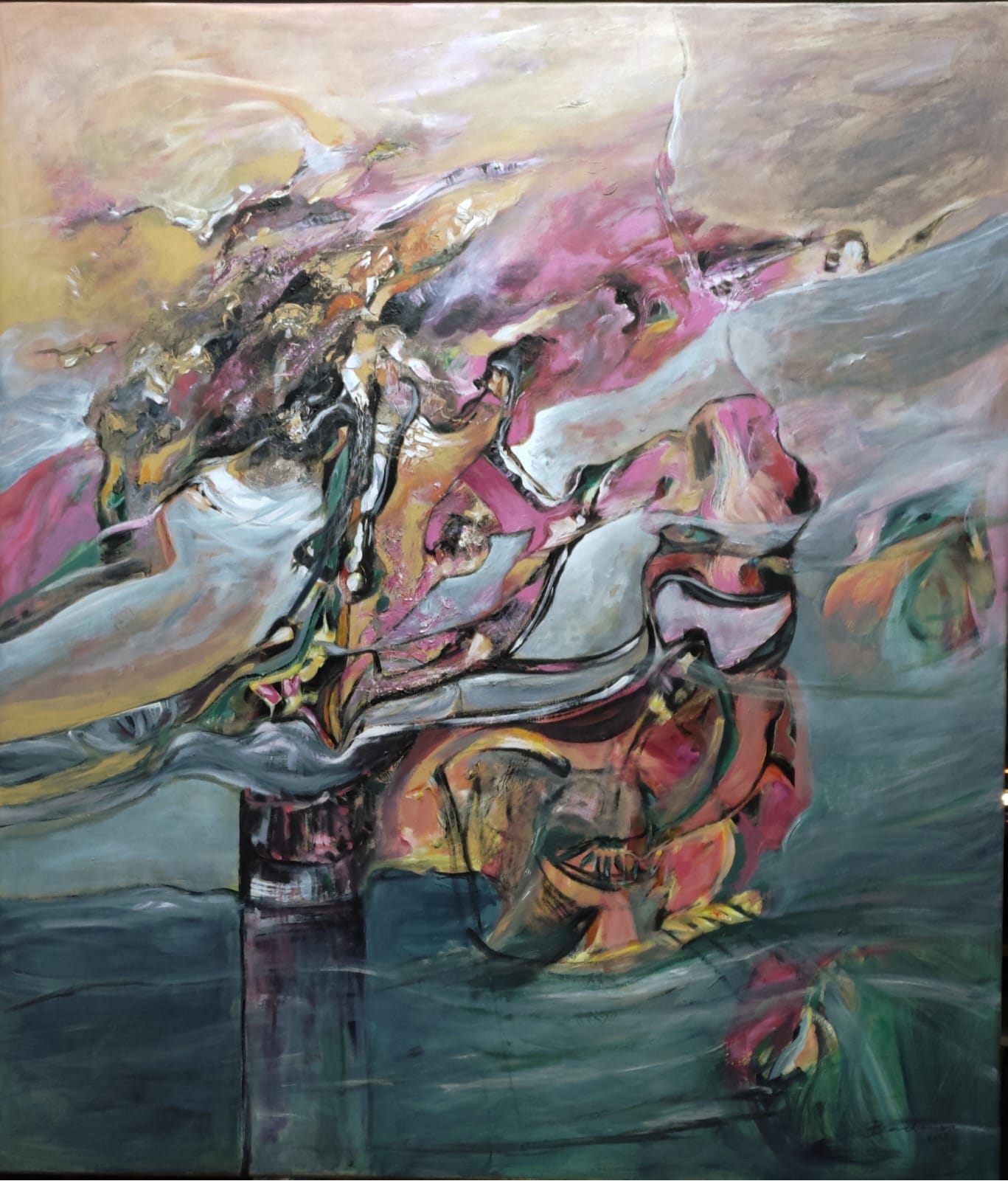
Imagen: Marta Badano, obra.
EL ESCORPIÓN Y LA TORTUGA

[Una teoría de la naturaleza impropia para los hablanteseres] [*]
“Es lo que hace que la ontología, dicho de otro modo, la consideración del sujeto como ser, la ontología es una vergüenza […]. J. Lacan (1)
LO SIENTO, ES MI NATURALEZA
Hay un tema muy complejo aquí, digno de un debate, sobre todo en nuestro Occidente posmoderno, neoliberal e hiperindividualista, que es la cuestión, para nosotros, los hablanteseres, de los postulados que se desprenden de esta fábula en relación a la naturaleza o la esencia del sujeto. Dichos postulados son los que se relacionan inmediatamente con aquello que llamamos Ser -a partir fundamentalmente del pensamiento griego- ya que ‘ser’ es solamente un verbo, una partícula copulativa que, por una maniobra sobre el lenguaje, deviene esencia o sustancia fundamental.
[En la fábula, el escorpión termina picando a la tortuga que, tras algunas desconfianzas, había aceptado ayudar al escorpión a cruzar el río. Éste finalmente la pica antes de llegar a la otra orilla, y frente a la pregunta de la tortuga, éste le dice antes de hundirse también: “lo siento, es mi naturaleza”.
PARMÉNIDES
Hemos tratado de revertir este asunto de muchas maneras (la historia de la filosofía es pregnante en la pregunta por el Ser) pero es difícil de combatir. De algún modo, dada la importancia que tiene el asunto del Ser en nuestro ámbito cultural Occidental nos cuesta salir del pensamiento parmenídeo: ‘el ser es, el no ser no es’. Lo que se revela en los típicos dichos que lo reflejan: ‘las cosas son como son’, ‘es lo que es’, ‘yo soy yo’… o tantos otros que aluden a la misma definición. La petrificación del ser sin dialéctica, servidora, por otra parte, del llamado ‘discurso del amo’, discurso promovido por Jacques Lacan en sus cuatro discursos: del amo, del histérico, del universitario y del analista, en el que un Significante (escrito S1),opera ocluyendo, tapando la división original del sujeto: su falta en ser.
FALTA EN SER
Para nosotros, más cerca de Heráclito que de Parménides, en verdad no hay ser sino falta en ser. Lo que sí se produce a veces, es una especie de suplencia de ser, ejemplo de ello son las identificaciones que, cuando son muy fuertes, se tornan muy difíciles de dialectizar. Las locuras (no las psicosis que obedecen a otro problema), las psicopatías, etc., dan cuenta de este asunto, producto de identificaciones pétreas, o de otras circunstancias que operan como respuestas del sujeto al Otro (familiar, social, cultural), tal como se aprecia también en los fanatismos de cualquier tipo.
LA PENA DE MUERTE
De hecho, la época del individualismo (moderno, en este caso), ya fue diagnosticada por Hegel (1) quien abordó el tema de la locura a través de las figuras del ‘alma bella’, el ‘delirio de infatuación’, la ‘misantropía’ o la ‘ley del corazón’, y que fue retomado por Lacan como su doctrina de la locura. En síntesis, la teoría que tengamos sobre estos asuntos incidirá de manera contundente sobre la forma de pensar el lazo social -las relaciones con los otros- y sus consecuencias: No es lo mismo concebir al otro, o a uno mismo (hay que cuestionar inclusive esta concepción del Uno mismo, de la mismidad) como individuo, cerrado como una bola o partícula, con exterior e interior, que concebirlo como sujeto dividido entre significantes, como asunto, tema o materia, producido “entre” parlanteseres. [Lacan usa la palabra francesa parlêtre] en el sentido de seres producidos por el habla y denominados ‘existencias’ sin consistencia tridimensional. Por otro lado, no olvidemos que la teoría-hipótesis de un supuesto ‘ser-esencia’ en el otro, a la manera de ‘este Es así y nada lo cambiará’, es la base constitutiva de los racismos, las xenofobias y de la mismisima pena de muerte.
IDENTIFICACIONES FÉRREAS
Creo que debemos intentar despojarnos, en lo posible, de esta cosmovisión, ya que nuestros propios prejuicios pueden empujar al otro a fijarse justamente en una determinada posición, a partir de cómo lo seguimos nombrando, pensando, tratando. Es un tema complejo que hay que resolver sin ingenuidades porque las identificaciones congeladas, petrificadas, que evitan pasar por el campo del otro/Otro, remiten muchas veces a las locuras, dependiendo de la mediatez o inmediatez de las identificaciones.
“El momento de virar lo da aquí la mediación o la inmediatez de la identificación, y para decirlo de una vez, la infatuación del sujeto” [J. Lacan, ‘Acerca de la causalidad psíquica’. Escritos 1.]
TEORÍA DEL CAMPO
Sin embargo, desde la ‘teoría del campo’, el contexto determina las jugadas mucho más que las partículas que lo forman. Lo que se resumiría en: X o cualquiera no es en sí mismo, sino en función del campo que lo determina. En resumen, solo la presentación de una teoría no individualista que rompe o ataca una concepción del sí mismo independiente del contexto y del Otro.
*Los acontecimientos producidos en Francia en estos momentos (Jun.-Jul. 2023) dan cuenta, en parte, de los problemas de las identificaciones y del tratamiento del otro/Otro en tanto ‘ser’. Esto se presenta también en la teoría nazi sobre la identificación: los otros son la ‘infección’, lo que hay que eliminar.
Datos bibliográficos:
1.”Fenomenología del Espíritu”, Hegel, G.W. F.
2.La locura, es abordada por Lacan en: “Acerca de la causalidad psíquica”, “Agresividad en psicoanálisis”; “Función y campo del habla y del lenguaje en psicoanálisis”, “Posición del inconsciente”, y otros textos.
3.”Las estructuras clínicas a partir de Lacan” Volumen I, Letra Viva. Alfredo Eidelsztein. / “Formalizaciones matematizadas en psicoanálisis” Seminario Apertura La Plata, 2006. Alfredo Eidelsztein, y otros textos.

Alexandre Koyré
Teoría contra teoría*
«Ahí reside la revolución filosófica de Schelling: no se limita simplemente a oponer el dominio oscuro de las pulsiones preontológicas, o lo Real innombrable que nunca puede ser totalmente simbolizado, al dominio del Logos, de la Palabra articulada que nunca puede «forzarlo» totalmente (como Badiou, Schelling insiste en que siempre hay un resto de lo Real innombrable, el «resto indivisible» que elude la simbolización)… La clave auténtica de la «locura» no es por tanto el exceso puro de la Noche del mundo, sino la locura que supone el paso a lo simbólico, la imposición de un orden simbólico sobre el caos de lo Real. » Slavoj Zizek.(1)
EXPERIMENTUM MENTIS
Un texto para reflexionar, tal vez de manera inversa. En principio, debemos decir que son teorías y no verdades absolutas, terminales. Así como la física de Newton tuvo que soportar una nueva teoría (Einstein, la relatividad) que mejoraba los impasses de la teoría anterior, cada teoría tiene el tiempo que dura su potencia, hasta que otra (supuestamente superadora) venga a ese lugar. Se trata finalmente de: teoría contra teoría. A partir de Galileo y su ‘experimentum mentis’ (experimento mental), ya no se parte exclusivamente de la experiencia sensible (Aristóteles), que dé garantía sobre determinadas elaboraciones conceptuales, y sobre todo dentro de la física moderna (cuántica, etc., aquella que Einstein rechazaba porque allí sí, Dios juega a los dados). Ya no es el experimento (luego puede haberlo, o no) lo que certifica cualquier teorización científica, sino su coherencia interna y su contrastación con otras teorías.
LA OPERACIÓN DE LACAN
La operación de Lacan sobre el psicoanálisis va en esa dirección: “no hay realidad pre-discursiva”. Es decir, en el principio está el Otro y el significante, aportando una teoría de lo real muy afín al de la física moderna, opuesto a lo planteado aquí por Zizek (un gran autor). Lo real de Lacan (que toma su definición de Koyré, su maestro también) es lo imposible, no algo que esté allí para simbolizarse, sino que pertenece al campo interno de la simbolización: sus impasses. Por ej: «es imposible que las paralelas se corten» que luego, para una nueva topología se convierte en: «es imposible que no se corten, en el infinito». Para eso se necesitó la creación de una novedosa topología de superficies bidimensionales (banda de Moebius, botella de Klein, cross-cap, toro, etc) Por tanto, la ciencia avanza de imposible a imposible, de manera teórica, abstracta, que luego puede dar lugar a experimentos, o no.
HIPOTÉTICO DEDUCTIVISMO
Únicamente las teorías son refutables por teorías mejores, siguiendo la línea epistemológica de Popper. Lacan trabajaba hipotético-deductivamente. Lo real de Lacan no es algo fuera del discurso que hay que simbolizar, sino un efecto, un impasse del mismo trabajo significante. Lo real aquí es efecto del significante, depende de él (definiendo significante como lo que no significa nada, salvo en relación a otro/Otro significante). Es por esa razón que se puede trabajar con lo Real desde el significante, no siendo prediscursivo (“No hay absolutamente ninguna realidad prediscursiva, dice Lacan).
ANUDADOS
Hay distintas teorías de lo real, incluso en ciencias. Lo interesante es que, cuando Lacan dibuja el enlace borromeo de tres, ubica en lo real la ex-sistencia y allí escribe ‘vida’, justamente por lo imposible de definir qué es la vida. Pero ese mal llamado ‘nudo’, es un enlace de tres registros y no se puede tomar ninguno por separado. No es entonces un real por fuera de lo simbólico y lo imaginario, sino que están anudados. Se habla del gozo como si equivaliera a lo Real, pero no es así (al menos en la teoría de Lacan). El ‘goce, no sería aquí entonces lo no dialectizable o no castrable, etc. (que es la vía que elige Miller para plantear el goce o mejor dicho ‘gozo’), sino que, al depender del significante, el ‘gozo’ es dialectizable, no perteneciendo al campo de lo Real. Siendo errónea la mención ‘lo real del cuerpo’ (ya que el cuerpo es Imaginario), o ‘lo real del gozo’, ya que ambos dependen del significante y por lo tanto son transformables.
LO REAL
Lo real aquí no es res extensa como la carne y el hueso, o las cosas tridimensionales del mundo, ni lo que no se puede decir (Lacan critica lo inefable, pero no dice que no exista, sino que, si es inefable, ¿para qué ocuparnos de ello?). Los imposibles entonces no son fijos, dependen de las variaciones de los impasses teóricos. Son distintas teorías sobre lo real: en una, lo real es como lo que Freud llamó pulsión de muerte, que una vertiente lacaniana transformó en goce del cuerpo o lo real del goce. Pero para Lacan el cuerpo no es real, sino imaginario: así lo escribe en el enlace borromeo de tres (Simbólico, Imaginario, Real), aquí lo Real es lo imposible lógico matemático, algo interno al propio orden simbólico y no por fuera de él.
UNA TEORÍA NO INDIVIDUALISTA
Hay mucha confusión en estas cosas, pues remiten a puntos de partida epistemológicos distintos. Freud se decía inductivista y quería ubicar al psicoanálisis del lado de la biología como modelo de ciencia. Lacan es deductivista, partía del lenguaje y no de la cosa sensible, 3D. Su inconsciente (el de Lacan) no estaría ‘dentro’ del individuo, como planteara Freud (el huevo freudiano: Yo-Ello-Superyó, que delimita interior de exterior es un ejemplo de ello), sino estructurado como un lenguaje y, según su fórmula: el inconsciente es el discurso del Otro. No se trataría entonces de una teoría individualista, sino en Immixión de Otredad (No hay sujeto sin Otro) (2).
————————————-
*Comentario que realicé a propósito de la locura y lo real en Zizek, en una publicación de Daniel Freidemberg en su muro (FB), a partir de una cita de Slavoj Zizek.
- Anexo: La locura (el otro ítem que menciona Zizek en su texto, en este sentido y en Lacan, es tomada desde las elaboraciones de Hegel y tiene que ver con las identificaciones, con las identificaciones directas al Ideal sin pasar, es decir, puenteando, el lazo con el Otro, el lazo social. Lacan la llama ‘…nuestra doctrina de la locura’ «Subversión del sujeto y dialéctica del deseo» Escritos 2.
- Esta expresión se deriva de una presentación de Lacan en Baltimore (EEUU), en 1966. «Acerca de la estructura como mixtura de una Otredad, condición sine que non de absolutamente cualquier sujeto» [Traducción de Leonel Sánchez Trapani, en la Revista Acheronta.
Referencias de lectura: S. Freud, J. Lacan, A. Eidelsztein, ‘Otro Lacan’, ‘El origen del sujeto en psicoanálisis’, y otros textos que responden al PIC de Apola, [Apertura para Otro Lacan. PIC: Programa de Investigación Científica].
Individualismo o entrelazamiento
«Existe hoy en día un modelado de la autoconciencia muy difundido que induce a la persona a sentir y pensar: ‘Estoy aquí, completamente solo; todos los demás están ahí afuera, fuera de mí, y, asimismo, cada uno de ellos recorre su camino con un interior que es él solo, su verdadero yo, y con un disfraz, exterior, que son sus relaciones con otras personas» Norbert Elias (1)
EL HOMBRE LOBO DEL HOMBRE (2)
Hay muchas confusiones en este punto: Freud, siguiendo a Le Bon (3) con la masa, y a Hobbes con el ‘hombre lobo del hombre’ (aunque esta cita no es de Hobbes y está inconclusa), opone masa a individuo, observando que la masa destruye al individuo, lo aliena, digámoslo así, reduciendo sus capacidades, su moral, etc. Es una teoría que parte de la creencia en un individuo sin Otro, como si hubiera algo esencial en el sujeto, una esencia que la masa destruiría.
SI EL SUJETO NO ES SIN OTRO
Si seguimos otra lógica, si el sujeto no es sin Otro o «el Otro está de entrada», tal oposición se diluye totalmente. Partir de un esencialismo prístino que la masa corrompería (aunque claro también se le añade su lado oscuro con la llamada pulsión de muerte), nos retrotrae a un individualismo que deja de lado la constitución propia del sujeto si la tomamos desde la teoría del significante que propone, por ejemplo, Lacan: el sujeto es lo que un significante representa para otro significante, o sobre el deseo como deseo del Otro, o del inconsciente como discurso del Otro, es decir no hay sujeto sin Otro. Temas, creo yo, sumamente importantes para una teoría política emancipatoria no individualista.
MARCEL MAUSS Y NORBERT ELIAS (3)
Autores como Marcel Mauss o Norbert Elias se han ocupado extensamente de este tema (autores, por otra parte contemporáneos de Freud, pero contrarios en este punto al individualismo freudiano). La teoría del “Don”en los intercambios, según la forma del Potlatch, en Mauss (Tomada por Lacan en su definición del amor como ‘dar lo que no se tiene…’), o la del «Entrelazamiento» en el caso de Elías, cuestionan las teorías individualistas sobre el sujeto. Entonces se trataría menos de preservar al individuo que de pensar su constitución a partir del Otro (el sujeto en immixion de Otredad), del significante y el lazo social. Más que lo singular (uno solo, único y sin par), o lo individual, podríamos sostener ‘lo particular’ del sujeto que de entrada, incluye al Otro.
_________________________________
*Algunas ideas en el contexto de las publicaciones de Nora Merlin sobre las declaraciones de Carlos Rosenkrantz [Ministro de la Corte Suprema de Argentina] Gracias Nora por los debates. Y a Alfredo Eidelsztein por sus cuestionamientos al individualismo en psicoanálisis. La expresión «Immixion de Otredad» pertenece a la presentación de Lacan en el Coloquio de Baltimore (1966), lo que quiere decir que no hay sujeto sin Otro.
- Norbert Elias (Breslavia, 22 de juniode 1897/Ámsterdam, 1 de agosto de 1990). Fue un sociólogo alemán de origen judío. Este párrafo corresponde a su libro «La sociedad de los individuos» (con artículos de 1939,1950 y 1987). Su concepción se basa en un concepto central: el entrelazamiento. Aportemos otra cita del mismo texto: “Actualmente no está nada clara la relación de la multiplicidad con el ser humano particular, el denominado ‘individuo’, la relación de la persona con la multiplicidad de seres humanos, a la que damos el nombre de ‘sociedad’. Pero las personas no suelen ser conscientes de que esto es así, ni mucho menos de por qué es así» (del prólogo).
- La frase completa que no es de Hobbes, sino del autor latino Tito Macio Plauto, en su obra Alsinaria o ‘La comedia de los asnos’, cuyo texto dice: “Lupus est homo homini, non homo, quom qualis sit non novit”, que significa: “Lobo es el hombre para el hombre, y no hombre, cuando desconoce quién es el otro”.
- Gustav Le Bon (1841/1931), “Psicología de las masas”
- Marcel Mauss, etnólogo, considerado uno de los padres de la etnología (Épinal, 10 de mayo de 1872 – París, 10 de febrero de 1950). La teoría del Don es de 1934. Sus trabajos en relación al Maná y al Potlach fueron muy importantes en sus tesis contrarias al utilitarismo, y a las teorías del libre mercado. La revista M.A.U.S.S. (Movimiento anti-utilitarista) define de esta forma la posición utilitarista: «El móvil fundamental del hombre es el deseo de maximizar sus placeres y sus posesiones materiales», a la que critica y rechaza.
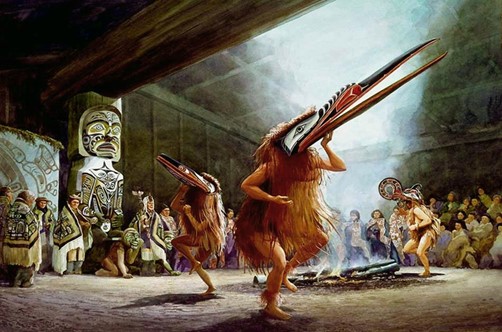
Imagen: “El Potlatch fue prohibido por parte del gobierno de Canadá, en el año 1884, por ser considerado un derroche improductivo contrario a los valores civilizados y cristianos de la acumulación. Sin embargo, esto no pudo evitar que se siguiera practicando de forma clandestina en los núcleos indígenas” [Pagina web ‘aprende-haia-El Potlatch-02-01-2018].
EL OTRO DEL CAPITAL
Lic. Juan José Scorzelli [*]
«[El Otro] Ya está instalado en su lugar antes de todo surgimiento del deseo» J. Lacan (1).
No es posible pensar el sujeto (efecto de lenguaje) prescindiendo del Otro. Lacan da un vuelco decidido con respecto a Freud poniendo todos los conceptos en clave de Otro (Ideal del Otro, deseo del Otro, inconsciente como discurso del Otro, síntoma como significado del Otro, etc.). En la conferencia de Baltimore [EEUU, 1966] conceptualiza al sujeto en immixión (Immixing) de Otredad (mezcla indiscernible entre sujeto y Otro). Es desde el Otro que vamos hacia el sujeto.
EL OTRO YA ESTÁ ALLÍ
El Otro entonces (tanto como A-Autre, barrado, o como Otro encarnado) tiene estatuto de anterioridad lógica a la constitución del sujeto: ‘el Otro ya está allí’ (2), dice Lacan. En este sentido se postula una teoría no individualista del sujeto, que tiene como base o apoyatura matemática una topología no euclidiana, sin exterior ni interior, que incluye superficies bidimensionales como la banda de Moebius, la botella de Klein, el cross-cap o el toro, para poder conceptualizar esta relación (entre sujeto y Otro), por fuera de la res extensa (partes extra partes) cartesiana, lo que le permite enunciar una tercer sustancia (no 3D) que llamó gozante (ni extensa, ni pensante).
LAS CARACTERÍSTICAS EPOCALES DEL OTRO
De allí que abocarnos a las características epocales de este Otro, sea necesario. El paso que da Lacan incluso sobre la pulsión, al colocarla bajo la égida del significante, separa definitivamente al psicoanálisis de todo biologismo y ontologismo (“Hontologie”, vergüenza de la ontología, será su neologismo). El ‘tiempo histórico’ del Otro del capital, como propone Jorge Alemán, o el contexto hiperindividualista del posmodernismo (caída de las utopías), no pueden dejarse de lado en un análisis del sujeto (sufrimientos, nihilismo, etc.) y de los fenómenos sociales más acuciantes.
_________________________________________________________________________
*Comentario que realicé a propósito de la publicación «Lacan y la comunicación en el capitalismo», por J. Alemán, en su muro (FB).
- Seminario VIII, clase XV.
- «[El Otro] Que siempre está entre nosotros». Seminario 3, clase XV.
Referencias: Alfredo Eidelsztein “El origen del sujeto en psiconanálisis: Del Big Bang del lenguaje y el discurso”, Ed. Letra Viva., 2018.
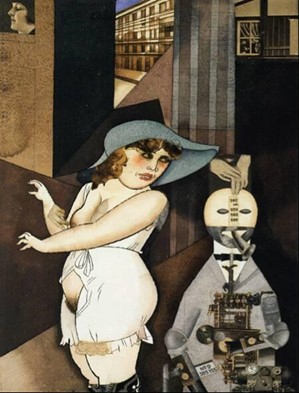
Imagen: George Grosz.

Notas para un debate sobre la cuestión del cuerpo en psicoanálisis
Por Lic. Juan José Scorzelli [*]
«[…] esta suerte de lugar que los estoicos llamaban incorporal. Yo diría que él es, a saber, precisamente, que él es el cuerpo» J. Lacan. (1)
El cuerpo en Lacan está del lado de lo Imaginario, hasta el final de su enseñanza. (2) Es el significante el que genera, incluso, los cuerpos. No habría cuerpo tal vez, sin el significante, solo organismo. La introducción del significante en lo real condiciona toda biología a sus articulaciones (las articulaciones significantes). Los cuerpos biológicos son sensibles al significante y toda pulsión, lejos de plantearse anclada en lo orgánico, es “el eco en el cuerpo del hecho de que hay un decir”. (Lacan, Seminario 23)
LA CUESTIÓN DE LOS GÉNEROS
La cuestión de los géneros debe pensarse teniendo en cuenta la primacía del significante (Nombre-del-Padre, Ideal del Otro I(A), falo, gozo, significante de la falta en el Otro, A barrado, etc.) y no la primacía de la carne y el hueso. El Nombre-del-Padre, como significante no tiene nada que ver con el padre de carne y hueso que impone la ley al niño, su función como ley en el Otro (A/), viene o no viene con la estructura (3) y, como el falo, no depende de la autoridad de nadie en particular, aunque alguien lo encarne o represente como figura de autoridad.
DESDE EL INICIO EL LENGUAJE Y EL OTRO
Plantear desde el inicio el lenguaje y la relación al Otro, no es lo mismo -y tiene diferentes consecuencias clínicas- que partir de la inscripción o no de huellas de satisfacción-insatisfacción que llegan del exterior o del interior al ‘aparato psíquico’. Una posición es creacionista, la otra evolucionista. La invención de Freud del dispositivo analítico con respecto al síntoma histérico, lo despega de lo orgánico y lo convierte en texto para leerse, y así nace la especificidad del psicoanálisis.
SUSTANCIA GOZANTE
Lacan radicaliza esta posición al alejarse progresivamente de los vestigios biologicistas presentes en Freud (pulsiones de vida y muerte, extremados luego por Melanie Klein), e intenta inscribir al psicoanálisis del lado de las ciencias conjeturales, en el espacio 2D (dos dimensiones) en el que se despliegan el inconsciente y sus efectos. Lo real no es el cuerpo sino lo imposible lógico matemático (lo que no puede escribirse) y la sustancia propia del significante, no es la res extensa ni la cogitativa (Descartes), sino la sustancia gozante. (4)
____________________________________________________________________
*Psicoanalista.
Ref. Jacques Lacan, Seminario 23, Alfredo Eidelsztein, Otro Lacan.
- Seminario 14. Sesión del 26 de abril de 1967, traducción personal de A. Eidelsztein, en Otro Lacan.
- Hasta su Seminario de Caracas en 1980, Lacan siguió escribiendo en los agujeros de su enlace borromeo: cuerpo en lo imaginario, vida en lo real y muerte en lo simbólico. Real, Simbólico, Imaginario. (RSI).
- El Nombre-del-Padre es un elemento, junto al Deseo de la Madre, que integra la llamada metáfora paterna, que tiene la función de introducir un límite, y se caracteriza por ser un nudo cuatripartito llamado punto de capitón o de almohadillado. “La metáfora paterna tiene la función de inscribir la castración como estructural y a nivel del tiempo como ‘desde siempre’”(Otro Lacan, A. Eidelsztein). Cuando el significante del Nombre-del-Padre se halla rechazado, operación llamada preclusión o forclusión en su traducción neológica al español, la castración no se inscribe adecuadamente como en los casos de psicosis, debilidad mental o respuesta psicosomática. Por otra parte, aunque el falo se transmite en el orden simbólico por estructura, la forclusión del Nombre-del-Padre, repercute en él causando su elisión: la elisión del falo, con resultados como la vivencia de muerte del sujeto.
- Sustancia gozante es la tercer sustancia, luego de la res extensa (partes extra partes) y la res cogitans cartesiana, que es creada por Lacan para situar la sustancia propia del significante.
- Imagen-Antonello Silverini-Ilustrador italiano –

La identidad no es la identificación [*]
«Es seguro que los seres humanos se identifican con un grupo. Cuando no lo hacen, están jodidos, están para encerrar. Pero no digo con eso con qué punto del grupo tienen que identificarse». J. Lacan, Seminario 22. RSI (15 de abril de 1975)
NO HAY ESENCIA NI IDENTIDAD
El sujeto se define identificándose sobre un fondo de falta en ser. No hay esencia ni identidad para el hablanteser (1). Diferenciar sujeto de individuo es necesario en este primer paso. Mientras el individuo, remite a lo indiviso, a lo que hace uno, incluso sin Otro en su constitución; el sujeto en cambio, efecto del lenguaje, adviene dividido de entrada y sin unidad posible.
EL IDEAL Y EL VALOR
Dos salidas al estatuto de división, llamado fading del lenguaje, se ofertan para la clausura, siempre inestable de este estado: la identificación al Ideal del Otro, escrito I(A) en el álgebra de Lacan o la salida a través del deseo del Otro, haciéndose su objeto, lo que supone una teoría del valor.
LA BEANCE Y LA LOCURA
No hay identidad para el hablanteser, solo habrá identificaciones, que suponen una clausura del vacío, la beance (2) propia de nuestro sujeto supuesto al inconsciente. Identificarse al Ideal sin mediación del lazo social, es lo propio de la locura, concerniente a las identificaciones directas que puentean la relación al otro/Otro, tal como lo propone Lacan en su diagnóstico de la locura, tomado de Hegel. La locura no es psicosis, es un fenómeno transversal a las estructuras clínicas (neurosis, perversión, incluso psicosis, respuesta psicosomática, debilidad mental, etc.).
HABILITAR EL VACÍO
Habilitar el vacío (objeto a) permite reformular, en la dirección de la cura, nuevas formas de reencontrar el deseo, de resolver la tiranía en que muchas veces se consolida allí un obturador que oficia de anudamiento suplementario en la estructura. En la teoría de los nudos se llama a esto sinthome (un cuarto lazo que mantiene juntos a los otros tres: lo real, lo simbólico y lo imaginario).
______________________________________________________________________
*Ref.: Jaques Lacan, Sem 3. Las psicosis. Alfredo Eidelsztein, Las estructuras clínicas a partir de Lacan (I), Félix Morales, Anudarse a la Lacan.
1.Neologismo creado por Jacques Lacan para nombrar los seres de lenguaje: en francés ‘parlêtre’, traducido por hablanteser, hablaser o desde la propuesta de A. Eidelsztein ‘hablanser’. Se lo ha traducido también como ‘ser parlante’, lo que no coincide con el espíritu de la posición antiontológica de Lacan, de modo que, anteponiendo el ser al habla podría suponerse algún ser previo a ella misma, el neologismo señalaría justamente lo contrario.
2.Del francés ‘beánte’, boquiabierto, estupefacto. Se tradujo al español por ‘hiancia’, pero este es un neologismo, es pertinente sin embargo la utilización del término ‘oquedad’.
Imagen, Antonello Silverini, ilustrador italiano.

La función psicoanálisis en la teoría y en la práctica del psicoanálisis
En la página 15 del Seminario 11, luego de plantear el tema de la excomunión y de la I.P.A. como comunidad religiosa, Lacan se pregunta:
” … digo primero que si estoy aquí ante un público tan grande en un ambiente como este (1) y con semejante asistencia, es para preguntarme si el psicoanálisis es una ciencia, y examinarlo con ustedes.”
Lacan insiste con esta pregunta en varios momentos de su Seminario y también la prosigue en el Seminario 12, específicamente “Problemas cruciales para el psicoanálisis”, solo que, en este momento, en el Seminario 11, va a interrogar los términos propuestos por Freud (inconsciente, transferencia, repetición y pulsión) y luego su pregunta se dirigirá al sujeto y lo real.
LOS FUNDAMENTOS DEL PSICOANÁLISIS
En principio habría que decir que el nombre más propiamente dicho de este Seminario (el 11) es: “Los fundamentos del psicoanálisis”. Aquí Lacan interrogará los fundamentos mismos del psicoanálisis, y si son válidos para constituir una ciencia y luego se detendrá en cada uno de esos cuatro términos para analizarlos y elaborarlos de una forma diferente a la que había realizado Freud.
Él comienza por decir: “¿Cuáles son los fundamentos, en el sentido lato del término, del psicoanálisis? Lo cual quiere decir: ¿qué lo funda como praxis?” (pág. 14).
Ante todo, define la praxis como el tratamiento de lo real por lo simbólico. Tenemos aquí entonces un punto central ¿cuál es ese real en nuestro campo? En nuestro campo, el del psicoanálisis al igual que en las ciencias modernas, lo real se define por lo imposible. La formalización del concepto de inconsciente que propone Lacan, lo aleja definitivamente del planteado por Freud y lo sitúa directamente en el campo del lenguaje. El sintagma “el inconsciente está estructurado como un lenguaje”, emancipa al inconsciente de todo fundamento biológico-pulsional correlativo de huellas mnémicas inscriptas a partir de estímulos externos o internos de satisfacción o insatisfacción tratadas como representaciones de cosa, es decir rompe con el inconsciente como representación del mundo exterior llamado realidad o macrocosmos (que remite esencialmente a la teoría de las esferas: mundos adentro de mundos), con la supuesta realidad sensible de los datos inmediatos o con cualquier forma de objetividad que tome esa realidad por lo real.
LA FUNCIÓN DEL SIGNIFICANTE
La clave fundacional se encuentra en lo que va a llamar la función del significante, que se distingue de la teoría de la representación, en el sentido que es una teoría diferencial de los elementos, donde ninguno es por sí mismo, sino en relación a otros. La teorización del significante hace caducar la tendencia unificante, ya que un significante no es idéntico a sí mismo, con lo que queda desmantelada la teoría de las esencias y del ser a nivel del sujeto. Un significante en sí mismo no garantiza ningún ser, sino multiplicidad de significaciones, pero a partir de otros y en relación con otros (co-variancia de los significantes), siempre parciales, y a la espera de una nueva (significación) por venir.
LA GARANTÍA Y EL TRATAMIENTO RELIGIOSO
Lacan cuestiona el tratamiento religioso que se dio a los términos utilizados por Freud, buscando en él la garantía de su uso y la garantía también de lo que es el psicoanálisis. Lacan intenta llevarlos a conceptos, sacarlos del oscurantismo y formalizarlos desde la teoría del significante, y asegurar transmisibilidad para demás ciencias afines. Los referentes ya no serán el aparato psíquico (adentro de alguien), ni el cuerpo biológico, ni la persona del autor, en este caso Freud, como aval de los conceptos que habitan el campo del psicoanálisis (el campo concerniente a las relaciones entre el lenguaje y el deseo).
El significante, como algo que no es posible definirse en sí mismo, contiene en esta misma definición, en esta misma imposibilidad, lo real del significante, si precisamos lo real como lo imposible, de la misma forma como situamos también lo imposible de la relación-proporción sexual, como lo que no puede escribirse. Así nuestro concepto inconsciente no necesitará referirse o garantizarse en el individuo y tampoco su sujeto (el sujeto supuesto hablar): formal, vacío y sin referencia sustancial ni ontológica, pudiendo trabajarse su teoría al modo abstracto en que lo realizan también las ciencias modernas, por ejemplo, la física teórica, las matemáticas, la lógica, etc.
UN SABER QUE SE INDEPENDIZA DE LO EMPÍRICO
Así el psicoanálisis va quedando del lado de lo que plantea Koyré para la ciencia: un saber que se independiza de lo empírico, y, podemos agregar, que va en contra de toda práctica sostenida en el ser de las cosas, lo que inaugura una clínica que cuestiona la estabilidad como absoluta, las esencias, lo inmutable. Como ejemplo de esto último tenemos las actuales teorías del goce como no dialectizable, como más allá o más acá de la castración, con el que uno podría amigarse o acotarlo un poco, en suma, un goce fuera del campo significante, lo que lo define como un ser, como una esencia última. Sin embargo, Lacan plantea el gozo (sería más apropiado nombrarlo así según Garate y Marinas) como articulado al significante, efecto del significante y el significante como vemos, imposibilita tanto el ser, como la esencia, como la unificación o cualquier concepción del mundo totalizante.
La teoría del significante entonces es ubicada por Lacan como la base, el fundamento. La posibilidad de transformar los términos en conceptos y dirigir la pregunta por el sujeto y lo real a partir de la función significante. Nuestra praxis entonces se funda en conceptos y se localiza en hacer hablar al sujeto, no al individuo, sino a aquel que suponemos que habla, transitoriamente coagulado en el mutismo del síntoma, hasta que pueda encontrar el lector de su significación.
Por eso dice Lacan al final del capítulo 1 del Seminario 11:
“Pero el análisis no consiste en encontrar, en un caso, el rasgo diferencial de la teoría, y en creer que se puede explicar con ello por qué su hija está muda (2) pues de lo que se trata es de hacerla hablar, y este efecto procede de un tipo de intervención que nada tiene que ver con la referencia al rasgo diferencial.”
________________________________
- (1) Lacan había sido recibido en la Escuela Normal Superior propiciado esto por su amigo Louis Althusser y habiendo suspendido antes su Seminario en Saint Anne, “Los Nombres del Padre”, del cual quedó registrada solo una clase, la primera.
- (2) Refiere a una escena de El médico a palos, de Moliére.
Referencias bibliográficas: J. Lacan, Seminario 11, “Los fundamentos del psicoanálisis”/ Félix Morales, Curso Los fundamentos del psicoanálisis, para las cuestiones del Seminario 11 /Martín Mezza, Seminario Problemas cruciales del psicoanálisis (APOLa Salvador Bahía), para las cuestiones del Seminario 12.
Imagen: Antonello Severini, ilustrador. (del FBK de Susana Resnik)

“¿QUÉ QUEREMOS?”
POR UN CAMBIO DE CONSTITUCIÓN PARA CHILE [*]
«No podemos solucionar nuestros problemas con las mismas líneas
de pensamiento que usamos cuando los creamos» A. Einstein
En la ciencia hay cortes epistemológicos, cambios de paradigma, donde el mundo que conocíamos cambia, y cambia porque lo pensamos de otra manera. Nuevas ideas en el pueblo chileno impulsaron las revueltas contra un paradigma ya acabado, el paradigma dictatorial, el antiguo régimen pinochetista. Hubo uno que gobernó toda la región, el de los golpes de estado, que sigue vivo hasta ahora, aunque se disfrace de lawfare: la imposición, en última instancia, de un modelo económico capitalista neoliberal, a través de la judicialización de la política.
Elaborar una nueva Constitución es también pensar con qué modelo se va hacia ello. En general, no hemos podido salir de la concepción cartesiana de la realidad (partes extras partes de la res extensa), allí donde solo podemos pensar al sujeto como individuo separado del otro, en una articulación de vecindad, pero también de choque. La ciencia ha dado un paso, pudiendo pensar mediante la dualidad onda-partícula, que la materia no solo funciona como corpúsculo, sino también como onda que se entremezcla. El modelo newtoniano seguirá sirviendo para algunas realidades del espacio tridimensional pero no para pensar realidades más complejas.
Chile no está solo, no es un corpúsculo, sino que está mezclado, entremezclado indiscerniblemente con toda la realidad latinoamericana y la del mundo, por ello, no es posible pensar Chile sin Latinoamérica. El espíritu de lo nuevo, que nunca es absoluto, sino que se basa en mucho de lo ya realizado, tendrá que pensar al sujeto y especialmente al sujeto país, si pudiéramos decirlo así, de una nueva forma, una forma no individualista, una forma ‘inmixturada de Otredad’ (1) de un Otro que alberga, por ejemplo, las históricas luchas emancipatorias latinoamericanas. Una Constitución que pueda ser base, fundamento de otras por venir.
Nuestra concepción de la realidad basada a veces en un realismo ingenuo, supuestamente dependiente de los hechos, no es más que una ilusión inductivista que tapona, sutura, que en el principio está la idea, y es en esas ideas, donde puede filtrarse -si no tenemos claro el modelo que las rige- lo que empañará todo tipo de concepción aparentemente novedosa volviéndola ‘más de lo mismo’. El aristotelismo reinante, donde primero está la física y luego la metafísica, podría extraviar nuestra posición certera a la hora de redactar, como es el caso, una nueva Carta Magna. Es la idea del sujeto, que no abandona su amarre en el individualismo más feroz, lo que porta un peligro para toda novedad que se inaugure. Ni el sol gira alrededor de la tierra, ni la tierra alrededor del sol en el centro, es la elipsis de Kepler la novedad, donde en el centro no hay nada. Dejar vacío el centro deja lugar para una dialéctica que no gira alrededor de nada en particular, sino que todos sus elementos, articulados en bucles con otros, no valen nada en sí mismos, sino por los demás.
La filosofía que sostiene a una dictadura es cerrada, absoluta, parmenídea, las cosas ‘son como son’; es conservadora y siempre mira al pasado. Lo nuevo no se ata al pasado, no lo mantiene más de lo necesario, y busca la invención, el porvenir, la creación. Concebir un sujeto nuevo para la nueva Constitución, es pensarlo formal, abstracto, fuera de la biopolítica, de las esencias, del racismo que dice qué es lo humano y qué no. Finalmente, el problema del ser. El sujeto así concebido, efecto del lenguaje y del deseo del Otro, sitúa sus coordenadas en un contexto histórico y cultural determinado y no como un ser único, individual, desamarrado de toda Otredad.
¡Viva Chile! Lo mejor para su Constitución, que será también la Constitución de todos. Ojalá! Así lo deseamos.
Lic. Juan José Scorzelli
Psicoanalista.
______________________________________________________________________
*Texto presentado en ocasión de la invitación a participar del Proyecto Arde.Chile 2 (Escritores de Chile en Acción, liderado por el escritor y poeta chileno Tamym Maulén), para ser incluido en el “Gran libro colectivo” que será entregado “a cada uno de los 155 constituyentes que serán electos los días 15 y 16 de mayo”, convocados para la redacción de una nueva Constitución.
1.Expresión utilizada por Alfredo Eidelsztein con relación al título de la Conferencia de Baltimore (1966), “Of Structure as an Immixing of an Otherness Prerequisite to Any Subject Whatever”, presentada por Jacques Lacan en 1966.
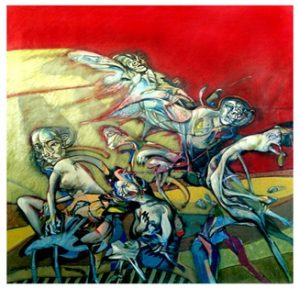
Luis de Bairos Moura (artista plástico, Tucumán, Argentina)
IMMIXING
Por Lic. Juan José Scorzelli [*]
La immixión es una mezcla que no admite la separación de sus componentes, como por ejemplo cuando mezclamos el café con el azúcar o hacemos salsa golf con mayonesa y kétchup, los elementos que la pudieron componer inicialmente se hacen indistinguibles.
EL SUJETO NO ES SIN OTRO
El sujeto de Lacan no es sin Otro, esto lo explicita en su Conferencia en Baltimore (1) en el año 1966, cuyo título está dado en inglés, ya que fue hablada en ese idioma (en realidad en una mezcla de inglés y francés) y es el siguiente: «Of Structure as an Immixing of an Otherness Prerequisite to Any Subject Whatever», y cuya traducción aproximada tomada de Leonel Sánchez Trapani de la Revista Acheronta sería: Acerca de la estructura como mixtura de una Otredad, condición sine qua non de absolutamente cualquier sujeto. La palabra immixing [en inglés puede escribirse tanto inmixing como immixing] tuvo problemas de traducción en la obra de Lacan, aunque con algunas diferencias, por ejemplo, en el Seminario de La carta robada de 1957, pero reescrito en 1966, en ocasión de la publicación de los Escritos dice:
IMMIXTION DES SUJETS
«La pluralidad de los sujetos, naturalmente no debe ser una objeción para todos los que están avezados desde hace tiempo en las perspectivas que resume nuestra fórmula: el inconsciente es el discurso del Otro. Y no habremos de recordar ahora lo que le añade la noción de inmixtion de los sujetos (immixtion des sujets), introducida antaño por nosotros al retomar el análisis del sueño de la inyección de Irma”
Es decir, se tradujo aquí immixion por inmixtion, que no existe en castellano, pero se entendió que el término tenía un valor neológico en Lacan. Marcelo Pasternac propuso su traducción como ‘entremezcla’. El término en francés existe y significa “acción de inmiscuirse o acción de meterse una cosa en otra cosa” pero Lacan altera este uso.
LACAN EN BALTIMORE
El asunto es que Lacan en su Conferencia de Baltimore no desarrolla el tema, sino que solamente está postulado en el título, aunque sí lo desarrolla en otras intervenciones durante los eventos en Baltimore. En una de ellas, a propósito del tema de la invención: ‘¿Quién inventa? ¿Cuál es el sujeto de la invención?’ (2) plantea la cuestión del estatuto del sujeto y dice:
«Estoy pensando en la palabra immixing (…) pienso que la primera vez que introduje esta palabra fue precisamente para la relación de los sujetos (…) Los sujetos no son entonces aislados como los pensamos. Pero por otro lado ellos no son colectivos. Tienen una cierta forma estructural precisamente immixing», y propone el término sujeto para esta conexión.
IMMIXTURADO DE OTREDAD
Ahora bien, en el Curso sobre la Ética, del 2001, Alfredo Eidelsztein postulaba la immixión de Otredad, como una concepción correspondiente a una ética para el psicoanálisis, una ética que diferencia netamente sujeto de individuo, sujeto no sin Otro. Esta es la cita:
“Cada vez que operamos con sujeto, debemos tener en cuenta cuál es la dimensión de Otredad que nos permita acceder a él. Pero, aunque nos permita acceder al sujeto, no accedemos nunca al sujeto como tal, siempre es en este prerrequisito, en esta condición sine qua non, de que sea inmixturado con Otredad. La ética que yo propongo desarrollar es exactamente esa: una ética que diga “no” a considerar en psicoanálisis al sujeto sin Otredad. El sujeto sin Otredad se llama “individuo”, e individuo es el máximo ideal, el ideal fundamental de Occidente.”
Esta posición no individualista, de Lacan para el psicoanálisis, se traduce claramente en esta cita de La cosa freudiana [pág. 398 de los Escritos I]:
“Los términos para los que planteamos aquí el problema de la intervención psicoanalítica hacen sentir bastante, nos parece, que la ética no es individualista.”
__________________________________
*Extractos del escrito ‘El sujeto de Lacan’, que presenté en Yoica el lunes 29 de marzo, 2021, junto a, Yhonn Escobar Jiménez de Apola Bogotá. [se puede descargar la presentación en el siguiente enlace: https://bit.ly/3cyYdhP ]
- El Congreso al que Lacan fue invitado junto con otros destacados de la época [Derrida, Hyppolite, Lévi-Strauss, Braudel, Jean Pierre Vernant y otros] se desarrolló en la ciudad de Baltimore (EE.UU), entre los días 18 y 21 de octubre de 1966. La conferencia de Lacan fue el 20 y realizó dos intervenciones el día 18, una durante la ponencia de Lucien Goldman, “Estructura humana y concepto metodológico”, y otra en la presentación de Jacques Morazé sobre “Invención literaria”. El título del Congreso fue “Los lenguajes críticos y las ciencias del hombre. La controversia estructuralista”.
- La intervención de Lacan realizada en la ponencia de Jacques Morazé sobre ‘Invención literaria’ [extracto].
Ref. bibliográficas: Jacques Lacan, Conferencia de Baltimore/ J. Lacan, Seminario 2/ J. Lacan, La carta robada, Escritos/ Pablo Peusner, Acerca de la pertinencia del término immixión en la definición de sujeto… (UBA, Psicología, 2005)/Alfredo Eidelsztein, Otro Lacan. / A. Eidelsztein, El origen del sujeto en psicoanálisis… / A. Eidelsztein, Ciencia y psicoanálisis. Curso en Apertura Sociedad Psicoanalítica de Bs. As.
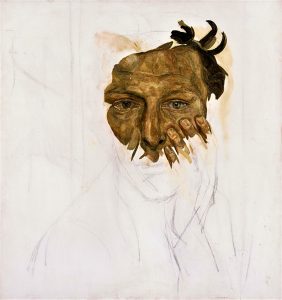
El goce no es la satisfacción pulsional, por Lic. Juan José Scorzelli
«Un cuerpo goza de sí mismo, él goza bien o mal, pero es claro que este gozo lo introduce en una dialéctica en la cual se necesita incontestablemente de otros términos para que eso tenga inicio, a saber nada menos que este nudo que yo les sirvo en bandeja» (Jacques Lacan) 1.
¿En qué cuerpo se satisface (Befriedigung) la pulsión, cuando ella es ‘el eco en el cuerpo de que hay un decir? El cuerpo del significante no es el cuerpo biológico ‘natural’, perdido para siempre luego de la creación significante, el discurso del Otro y el lazo social que habilita.
EL CUERPO Y EL GOCE
El cuerpo y el goce del que habla el psicoanálisis a partir de Lacan [en Freud el cuerpo biológico sigue operando en la trama de su teoría] son efectos del significante y el agujero, ellos están en ese nivel. No existen en el nivel biológico de la carne ni en el espacio tridimensional (3D). La dimensión topológica de la botella de Klein o el toro pueden dar cuenta de estos espacios ‘bidimensionales’.
NECESIDAD DE DISCURSO
El goce [que nada tiene que ver con la pulsión ni con la satisfacción de esta], como necesidad de discurso, habita el agujero [o sistema de agujeros] creado por el significante a partir de la inexistencia. El agujero nace del bucle significante (S1-S2). El cuerpo del que Lacan ofrece una nueva intuición con el enlace borromeo (Real, Simbólico, Imaginario), no existe en el espacio de tres dimensiones, sino en el espacio topológico y matemático (compacidad).
EL SUJETO NO GOZA DE SU CUERPO
El sujeto no goza de su cuerpo, sino que el cuerpo goza de sí mismo ‘en el contexto del nudo borromeo’. Lo cual supone al Otro. Sujeto y Otro, en Inmixión de Otredad (2). No hay sujeto sin Otro. Los cuatro elementos del psicoanálisis: significante, sujeto, cuerpo y goce pertenecen al espacio abstracto del psicoanálisis, como efecto de la condición significante de nuestras estructuras. «En el principio es el Verbo» o en el principio es el lenguaje y el Otro, desmienten la primacía originaria de cualquier autoerotismo desamarrado del Otro.
_______________________________________________________
* Puntuaciones realizadas a partir de la lectura ‘Otro Lacan’, de Alfredo Eidelsztein. 1. «Le séminaire XXI».
O GOZO NÃO É A SATISFAÇÃO PULSIONAL (Traducción al portugués e imagen por José Marcus De Castro Mattos)
\Texto de JUAN JOSÉ SCORZELLI (*)/
Em que corpo se satisfaz (‘Befriedigung’) a pulsão, quando ela é ‘o eco no corpo do fato de que há um dizer’? (Cf. LACAN, J. Seminário 23.)
O corpo do (desde o) significante não é o corpo bio-natural, pois este está perdido em sempre na instituição do significante, no Discurso do Outro e no laço social.
O corpo e o gozo dos quais fala a Psicanálise a partir de Lacan (em Freud o corpo bio-natural segue operando na trama de sua teoria) são efeitos do significante e do furo (‘trou dans le symbolique’, em termos lacanianos): eles estão situados nesse nível.
De fato, o corpo e o gozo não existem no nível biológico da carne nem no espaço euclidiano (tridimensional) e a dimensão topológica da Garrafa de Klein ou do Toro podem mostrar a bidimensionalidade deles.
O gozo como necessidade de discurso (que nada tem a ver com a pulsão ou com a satisfação desta) habita o furo ou o sistema de furos instituído pela ex-sistência do significante vis-à-vis aos significados, pois o furo nasce do pareamento entre S¹ e S²; assim, o corpo do qual Lacan oferece uma nova apreensão com o Nó Borromeano não existe no espaço euclidiano (tridimensional) e sim no espaço topológico e matemático (‘compacidade’).
Logo, no contexto do Nó Borromeano o sujeito ($) não goza de seu corpo, posto ser o corpo que ‘goza de si mesmo’, mas um ‘si mesmo’ que supõe o Outro, ou seja, a ‘intromistura com a Alteridade’ (não há sujeito sem Outro, etc).
Os quatro elementos da Psicanálise (significante, sujeito, corpo e gozo) pertencem a um espaço abstrato, como efeito da condição significante de nossas estruturas.
Enfim, ‘No princípio é o Verbo’ – no princípio é a Linguagem – desmente a primazia originária de qualquer autoerotismo desarticulado do Outro.
(Pontuações realizadas a partir da leitura de ‘Otro Lacan’, de autoria de Alfredo Eidelsztein.)
(*) J. J. SCORZELLI. Psicanalista.
{A foto representa um esboço de autorretrato do pintor inglês LUCIEN FREUD [1922 – 2011].}
1. Clase del 11 de marzo de 1974. El sujeto es efecto del lenguaje, del Otro y del lazo social. El individualismo se combate con la noción de immixión de Otredad (No hay sujeto sin Otro), y con una teoría del sujeto que no arranque de la sustancia, ni de un ser que no sea de lenguaje.
2. Immixion de Otredad: La noción (o concepto) de immixion de Otredad (“Acerca de la estructura como mixtura de una Otredad, condición sine qua on de absolutamente cualquier sujeto”, J. Lacan, conferencia de Baltimore, 1966) donde habla de una entremezcla indiscernible entre sujeto y Otro o, no hay sujeto sin Otro, se ubica en esa dirección: antiindividualista, antiontológica (no hay seres más que de lenguaje: parlanteseres), y antinihilista.

EL DESEO NO ES EL QUIERO
“Se anuncia una ética, convertida al silencio, por la avenida no del espanto, sino del deseo” J. Lacan (1)
El deseo no es el quiero, pues puede ser justamente lo contrario. Allí juega la distinción entre el Yo quiero o el eso desea, ya que, eso desea en mí, sin que yo lo sepa. Dos fórmulas se desprenden de estas enunciaciones: Te quiero aunque no quieras o te deseo aunque no lo sepa. Un abismo las separa: en una se adivina el forzamiento, en la otra, el pañuelo hace causa de un deseo que se suscita, sin que se muestre la premura solicitante (de la posición sexuada que sea).
EL OBJETO DEL DESEO
“¿No será más bien, como me ha ocurrido decirlo, botella de Klein, sin adentro ni afuera? ¿O aun, sencillamente, por qué no, el toro?” J. Lacan (2)
El deseo así es en principio inconsciente: articulado pero no articulable, decía Lacan, pero interpretable su objeto: el objeto del deseo. Para ello es el toro la mejor superficie, una cámara de auto o un salvavida muestra su estructura al sumergirse en un espacio de tres dimensiones, ya que su origen es topológico, de dos dimensiones sin adentro ni afuera, en la que el agujero central se halla en continuidad con la periferia. Es allí donde las vueltas de la Demanda, que constituyen su directriz, evocan en su cierre (operado por el analista) un más allá donde el deseo puede donar su objeto. Así, se cumple el veredicto: el deseo está más allá de la Demanda (del Otro). El fantasma es su sostén, el fantasma está en el campo del Otro (J. Lacan. Seminario 10, La angustia).
COMO OTRO, DESEO
«Of Structure as an Immixing of an Otherness Prerequisite to Any Subjet Whatever» J. Lacan (3)
El deseo como deseo del Otro, implica que deseo como Otro. Y Lacan pone de relieve que el sujeto solo es abordable desde el Otro, en Immixión de Otredad. La Immixión es mezcla indiscernible, donde los elementos mezclados son imposibles de separar, por ej.: la mezcla de agua con azúcar. Esta concepción rompe con todo individualismo, ya que el inconsciente de Lacan no está dentro de ningún individuo y sus límites no son los del cuerpo biológico, sino que habita en un espacio no 3D, sin adentro ni afuera, allí mismo donde podríamos situar el lenguaje en general. Es en este sentido que Lacan cuestiona la autoría, ¿quién es el autor?, poniendo como ejemplo las invenciones realizadas por dos o más científicos sobre el mismo tema, en el mismo momento histórico, sin conocerse entre sí (los alemanes August Ferdinand Möbius y Johann Benedict Listing conciben al mismo tiempo y de forma independiente la banda nombrada luego como de Möbius, en 1958). La dimensión del sujeto y del Otro no pertenecen al espacio euclidiano. Sujeto y Otro deben pensarse no como partículas sino más bien como ondas (teoría onda-partícula), interpenetrables.
____________________________________________________________________________
- Jacques Lacan. Libro 7: “La ética del psicoanálisis” (1969-60), Buenos Aires, Paidós, 1988.
- Jacques Lacan. Seminario de Caracas, Venezuela, 1980.
- Jacques Lacan. Conferencia de Baltimore (EEUU 1966). “Acerca de la estructura como mixtura de una Otredad, condición sine qua non de absolutamente cualquier sujeto”. [Traducción de Leonel Sánchez Trapani en la Revista Acheronta].
Arte – Carlos Alonso – «Adam and Eve Expelled from Paradise» – Expresionismo – 1969
A PARTIR DEL VERBO (EL SIGNIFICANTE) Y LA RELACIÓN AL OTRO
«El dolor es siempre personal y siempre cultural. Está, por eso, siempre abierto a la variable influencia del significado» 1.
«La sola presencia de la primera función de onda en algún lugar del universo ejerce cierta influencia en cualquier otra función de onda» 2.
A PARTIR DE LA IDEA
Creo que Lacan aporta al psicoanálisis elementos abstractos decisivos no tomados en cuenta antes, reafirmando su inicio, no en el campo biológico (como las pulsiones freudianas o la pulsión de muerte cuantitativa en Melanie Klein), sino a partir del Verbo (del significante), y de la relación al Otro. Para ello fue necesario también su relación con la topología o la física teórica. ¿Por qué? Por el aporte de las superficies interpenetrables, sin exterior ni interior, que permiten ir más allá de cualquier teoría individualista que tenga como referencia al cuerpo como uno (con adentro y afuera, a la manera del huevo freudiano). Asimismo, su concepción teórica es a partir de la idea, del método hipotético deductivo, no del inductivismo, ni de la experiencia. La experiencia, en todo caso, responde de la teoría en la que se basa -su marco teórico-, lo que se llama una praxis. Es el experimentum mentis, es decir la experiencia mental, la que mejor corresponde al modelo de investigación en ciencias conjeturales (todas lo son, especialmente el psicoanálisis).
IMMIXION DE OTREDAD
Esto constituye todo un paso para pensar al sujeto a partir del Otro, en Immixion de Otredad, como Lacan postula en la conferencia de Baltimore, en 1966 (3). Las superficies topológicas abren el campo para concebir lo imposible, así como se piensa el imposible lógico-matemático: superficies bidimensionales como el cross-cap o la superficie de Klein (superficies cerradas de una sola cara y un solo borde, sin interior ni exterior) que no pueden sumergirse en el espacio 3D, o como el caso de las paralelas que no se cortan del 5to. postulado de Euclides, luego contradicho por Nikolái Lobachevsky en su geometría no euclidiana, inaugurante de una nueva topología, para pensar los imposibles en el campo de la ciencia.
EL SUJETO DE LACAN
El sujeto de Lacan (en mezcla inseparable con el Otro) es la clave para pensar estos problemas ya que se lo presenta como efecto del lenguaje; es insustancial, vacío y no tiene ser, está dividido entre significantes, no es el sujeto antropológico, ni el sujeto gramatical, ni el ciudadano, es el tema, el asunto (sujet, en francés), que se despliega entre hablanteseres (encarnaciones del lenguaje), allí donde Eso habla entre ellos. Esto es un verdadero cambio de paradigma dentro del psicoanálisis (o corte epistemológico, según se lea) que tal vez permita salir del individualismo (donde no importa quien lo dice, analista o analizante, sino que Eso habla entre ellos), del sustancialismo y del biologismo reinantes.
________________________________
1.»La cultura del dolor», David. B. Morris. Santiago de Chile (1993). 2.»Antes del Big-Bang», Martin Bojowald, Buenos Aires: Debates. (2010). 3.»Acerca de la estructura como mixtura de una Otredad, condición sine qua non de absolutamente cualquier sujeto«[«Of Structure as an Immixing of an Otherness Prerequisite to Any Subjet Whatever»] Traducción de Leonel Sánchez Trapani, en la Revista Acheronta.
Referencias: Jacques Lacan, Escritos 1 y 2, Editorial Siglo XXI. Alfredo Eidelsztein, «Otro Lacan», «El origen del sujeto en psicoanálisis, del Big-Bang del lenguaje y del discurso», «La topología en la clínica psicoanálisis». Ed. Letra Viva.
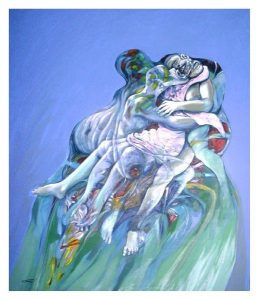
—»El beso»—Luis De Bairos Moura-De la serie «Humaniquiestal»—Acrílico-1989—

29/01/2021
Da Eliminação Da ‘Centro’
A ‘ferida narcísica’ foi Kepler e não Copérnico, ou seja, retirar o ‘centro’: Lacan fura o ovo freudiano, convertendo-o em um toro (superfície topológica).
\
Lacan dá um passo além ao tomar Kepler como aquele que descentra, pois isto é mais parecido com as consequências da ‘Outra-cena’ (freudiana) e à postulação do Eu (Ich/Je) como ‘Eu é um Outro’ (Je est un Autre).
/
Kepler descentra, ou seja, rompe com o ‘centro’ (Terra ou Sol) e localiza a elipse (a qual questiona a forma esférica perfeita tradicional), estabelecendo dois polos, um deles vazio.
\
Ora, ao transformar o ovo freudiano em um toro, Lacan o fura, colocando no centro o vazio.
/
O interessante é que não se tratava de substituir um centro por outro, mas sim da eliminação do ‘centro’: por exemplo, no tocante à teorização de Lacan sobre o ‘sujeito’, trata-se de um sujeito descentrado, vazio, dividido (o sujeito não é o ‘eu’).
\
(O tema da substituição do circular pelo elíptico é também interessante, porque a esfera era considerada a figura perfeita, ou seja, caem muitos mitos nesta substituição.)
/
Além disso, Lacan trabalhava as superfícies topológicas sem interior nem exterior, o que constitui outro desafio à crença no individualismo: a ‘intromistura de Alteridade’ (não há sujeito sem Outro) coloca em questão a tese individualista, posto que o ‘eu penso’ e o ‘eu falo’ estão sobredeterminados pelo ‘sou pensado (pelo Outro)’ e pelo ‘isso (o Outro) fala, pensa e goza’, questionando-se assim o ‘sujeito da ciência’ (cartesiano).
\
Enfim, a importância de manter o ‘centro’ vazio é também clínica, mas os substancialismos comparecem para impedi-lo.

Tradução do original espanhol:
JOSÉ MARCUS DE CASTRO MATTOS
Psicanalista
Escritor
Poeta
Coordinador de:
ⱾEMINARIOS ⱣSICANALÍTICOS IACQUES ŁACAN
ⱾEMINARIOS ⱣSICANALÍTICOS YOÁN ₲UIMARANES ℟OSA
Miembro del Colegiado Director de: ĔSCUELA ⱣOPULAR DE ⱣSICANÁLISIS ɃRASILEÑA (ĔⱣⱣɃ)
24/01/2021
ESENCIALISMO Y PERONISMO [*]
«…, el universo olvida el valor exacto que tenía cualquiera de estas características con anterioridad al Big Bang.» M. Bojowald (1)
” … lo que había [el ser] allí desaparece por no ser ya más que un significante” J. Lacan (2)
Un problema que ha de tratarse, previo a la significación ‘peronista’, o qué es o no ser peronista, es el esencialismo, la maldita idea de una esencia de las cosas, que deviene de una utilización ontologizante del verbo ser, que es, en tanto tal, un conector. Si no podemos desontologizar al peronismo (o lo que sea), caeremos en fundamentalismos ontológicos peligrosos, incluso tendientes hacia la sustancialización, bases de todo racismo, xenofobia, etnocentrismo, etc.
LA APROPIACIÓN ONTOLÓGICA
La apropiación ontológica trabaja con el ser de las cosas, con las esencias. Recordemos la diferencia entre Parménides (el ser es, el no ser no es) y Heráclito (ni entramos dos veces al mismo río, ni somos los mismos cada vez). El tema es retomado por aristotélicos (partir de los sentidos) y platónicos (partir de las ideas). La posición, la argumentación peronista (si no somos parmenídeos) parte de ideas, arranca de una idea. La idea no tiene exactamente propiedad privada, ella adviene, se produce en el campo del Otro (la cultura, el lenguaje, el contexto social). Por supuesto son expuestas por alguien o ‘alguienes’ (se da el caso de que la misma idea aparece en sujetos de muy distantes lugares o sin contacto entre sí), es lo que, de todos modos, llamamos un autor o autores. Las ideas, como en la ciencia, están sujetas a transformaciones, a cambios de paradigma (de la teoría de Newton a la de Einstein, luego Max Planck descubriendo la teoría cuántica de campos o, la teoría de cuerdas dependiente de la cuántica, anticipada por Theodor Kaluza). Eso cuestiona cualquier esencialismo.
SUJETO
Recordemos la definición lacaniana de Sujeto (no es individuo ni persona) como falta en ser, vacío, dividido entre significantes. El peronismo (o los peronismos), no están ajenos a estos cambios, de hecho tal vez el kirchnerismo podría asociarse a esta mutación (recordemos que Einstein rechaza la física cuántica, que era hija, por decirlo así, de la física relativista). El rechazo al cambio de paradigma, a la mutación, puede ser un gran retraso en el avance de las ideas (aunque no se sepa de antemano si sus consecuencias serán mejores o peores). Aferrarse a esencias no es lo mismo que asentarse en principios, en argumentos o hipótesis iniciales, ya que estas pueden ser cambiadas, modificadas. No hay esencia, ni ontología o sustancialismo que no amarre finalmente en la biopolítica, en la política de los cuerpos. Debemos, si se puede, partir de nuevas concepciones del pensamiento que no embraguen con biología alguna (para el campo de las ideas). Toda la ciencia (no aristotélica) trabaja en ese sentido. Esto permite salir de una concepción individualista y pensar al sujeto (del inconsciente) en Immixion de Otredad (mezcla indiscernible con el Otro). (3)
SIN ADENTRO NI AFUERA
Lacan utiliza una topología no euclidiana sin adentro ni afuera (sin exterior ni interior) para pensar esta cuestión del sujeto (a la manera de las superficies topológicas interpenetrables, que permiten ir más allá del ‘partes extra-partes’ cartesiano). Toda biología queda en otro plano, totalmente afectada por la estructura significante del lenguaje. Una política que supere el individualismo, el sustancialismo y la ontologización, daría un nuevo vuelo a las viejas concepciones esencialistas. En la física moderna por ejemplo, un elemento (electrón), puede leerse como onda o como partícula, en la onda los elementos se entremezclan, no tienen masa y se despliegan en el espacio, mientras que las partículas o corpúsculos ocupan un lugar en el espacio y poseen masa (‘dualidad onda-partícula’), según la posición que elija el experimentador. La teoría del sujeto de Lacan también comparte esta dualidad: el sujeto como onda, sin masa, en immixión o como partícula, encarnado, lo que llamamos ‘hablanteser’ (seres creados por el lenguaje). Hay una tendencia actual (de hecho, es la que triunfa) hacia el biologismo, o como decía Foucault, la biopolítica, el sustancialismo y la ontologización que se desprende de estas posturas aun aristotélicas y medievales. (4)
Asunción, enero, 2021.
_____________________________
*Escrito a propósito del texto de Jorge Alemán «Peronismo», en su muro. Véase también https://lateclaenerevista.com/el-mas-peronista-de-todos-los-peronistas-por-jorge-aleman/?fbclid=IwAR0XLtDW5Xay8WzXKQCNiNiPz6eM3KefjCBTIeHoEReF3dKXkqYcynubvGY
Ref., Lacan, J. (1984). El Seminario. Libro 2. Libro 17 / Paidós. / Posición del inconsciente, J. Lacan, 1960/64. Escritos/ El origen del sujeto en psicoanálisis, del Big Bang del lenguaje y el discurso, A. Eidelsztein, Letra Viva/ Otro Lacan, A. Eidelsztein, Letra Viva. / Conferencia de Baltimore, J. Lacan, dictada en Baltimore (EEUU), en ocasión del Simposio Internacional del Centro de Humanidades John Hopkins, el 21 de octubre de 1966.
- Martin Bojowald. M. (2010). Antes del Big Bang.
- Jacques Lacan, Posición del inconsciente.
- Immixión de Otredad: Lacan titula su conferencia (conocida como la conferencia de Baltimore), dictada en Baltimore (EEUU), en ocasión del Simposio Internacional del Centro de Humanidades John Hopkins, el 21 de octubre de 1966, como «Of Structure as an Immixing of an Otherness Prerequisite to Any Subject Whatever». [«Acerca de la estructura como mixtura de una Otredad, condición sine que nonde absolutamente cualquier sujeto».La traducción realizada directamente del inglés, por Leonel Sánchez Trapani en la Revista Acheronta N° 13 de Julio del 2001]. La immixión es una mezcla que no admite la separación de sus componentes como por ejemplo cuando mezclamos el café con el azúcar, o hacemos salsa golf con mayonesa y kétchup, los elementos que la pudieron componer inicialmente luego se hacen indistinguibles. [en inglés, las escrituras immixing o inmixing son igualmente válidas]. De ‘Immixion de Otredad’, conferencia personal dictada en APOLa Bogotá, 21 de agosto, 2020. Extractos.
Nota: Sujeto y hablanteser: El sujeto de Lacan se diferencia del sujeto antropológico, es efecto del significante, dividido entre ellos, no es sustancial ni ontológico. Lo caracteriza su falta en ser. Es la suposición con la que se trabaja con respecto al inconsciente (sujeto del inconsciente). El hablanteser sí es uno, pero incluye la relación al Otro, en este sentido no es Individual.
- En este trabajo (que antecede un desarrollo por venir) se toma en cuenta la hipótesis de Alfredo EIdelsztein sobre el Big Bang del lenguaje, el Otro y el lazo social como anterioridad lógica a cualquier naturalismo, biologismo o teoría individualista del sujeto.

_______________________________________________________________________________
NUESTRA VIDA SIGNIFICANTE [*]
“El hombre está capturado por la imagen de su cuerpo” (1)
Según nuestra lectura es necesario cuestionar la concepción individualista de la constitución del sujeto. Nuestra posición es que no hay sujeto sin Otro, sin lenguaje y sin lazo social. Vale decir, no hay una sustancia que evoluciona en diferentes estadios madurativos que da como resultado un sujeto humano hablante. El sujeto es efecto del lenguaje y se constituye por los mecanismos de la alienación y la separación [En nuevas notas trataremos sobre estas operaciones lógicas en el advenimiento del sujeto] (2)
EL MALESTAR EN LA CULTURA
¿Qué quiere decir todo esto? Quiere decir que concebir un sujeto sustancial que evoluciona y va aprendiendo el lenguaje y la cultura que va a habitar, es una concepción evolucionista (en este sentido, la posición de Lacan es creacionista, creación ex -nihilo, en el principio es el Verbo, en nuestro caso: en el principio es el significante), que invierte los procesos y tiene como consecuencia la elaboración de un sujeto individual, recortado de la biología, similar a la que creemos encontrar en los llamados animales. El malestar en la cultura estudiado por Freud mantiene vivo este punto de vista, ya que supone un sujeto pulsional originario, que se enfrenta a una cultura que intenta dominar esas ‘pulsiones’ para domesticarlas y socializarlas, por lo tanto habrá malestar en el sujeto por tener que renunciar a ese goce de origen, y esto gracias a la función del padre, que impondrá la ley bajo la forma de prohibir el incesto y el concomitante goce masturbatorio. Con Lacan tenemos una revisión de todo este asunto, incluso un rechazo de esta lectura, ya que elimina este supuesto antagonismo, sujeto-cultura, poniendo al Otro de entrada, al sujeto como efecto del lenguaje y a la cultura como incluida dentro de sus leyes (del lenguaje), es decir, no hay en Lacan un sujeto previo a la acción del lenguaje, no hay baño de lenguaje sobre un sujeto que está ya allí esperándolo, solo hay sujeto efecto del lenguaje, y no hay realidad prediscursiva.
EL ENGAÑO
Son muchos los casos en que el sujeto se siente mal con su cuerpo, con eso que ‘ve’ en el espejo. Se puede sentir gordo, feo, flaco o incluso hermoso y sin fallas. Muchas depresiones tienen su aparente origen en lo que se ve allí, en ese espejo que parece reflejar sin cuestionamientos lo que vemos. Esta concepción individualista no tiene en cuenta lo que vinimos desplegando en los párrafos anteriores, habría allí que advertirle al sujeto del ‘engaño’, de un engaño fundamental, que lo que allí ve no necesariamente es puro, directo y objetivo, sino que hay Otra escena, la escena que condiciona esa mirada, los significantes y los ideales que la sostienen, los ideales del Otro (Ideal del yo, en Freud) en el centro mismo de su advenimiento. Es necesario reenviar el engaño imaginario, constitutivo de lo que podríamos llamar nuestra ‘estructura’ (que en Lacan reemplaza al ‘aparato psíquico’ freudiano, que se encuentra en el ‘interior’ del individuo, por una concepción topológica sin adentro ni afuera, y con un sujeto bidimensional), hacia esa Otra escena, en la que puede hallarse el secreto, la significación de lo que toma forma en lo que parece que vemos con tanta nitidez y seguridad.
EL SUJETO DEL SIGNIFICANTE
He mezclado en mis dichos dos concepciones de la subjetividad que deben discriminarse: el sujeto como efecto del lenguaje, el sujeto del inconsciente, el sujeto lacaniano, dividido entre significantes, que no tiene posibilidad alguna de unidad, salvo a la que se tiende cuando el ideal es erigido para rechazar tal división y emerger como emblema de hierro, como vemos por ejemplo en los fundamentalismos religiosos y/o políticos de ciertas características. Por otra parte, está lo que designamos sujeto coloquialmente (este o aquel sujeto, como individuos) que lo podemos asimilar al denominado ‘hablanteser’ de Lacan, queriendo decir que no hay ser sino del habla, no hay ser sustancial, sino sustancia de lenguaje o materialismo de la palabra (móterialisme, al decir de Lacan). De todas formas en uno u otro caso, en una u otra manera de hablar del sujeto, ‘no hay sujeto sin Otro’.
EL OTRO
Esto extrae a nuestro sujeto de toda biología, ella como tal quedará perdida, olvidada y la marca del significante atravesará cualquier concepción de la realidad que hagamos, pues todo será leído, teorizado, elaborado, desde la concepción lenguajera que tengamos de las cosas, y en última instancia, en nuestra realidad ‘humana’, las cosas serán creaciones del significante. Esto para el psicoanálisis es esencial, pues trabajamos allí donde el padecimiento, el dolor subjetivo, implican al Otro, en sus dos dimensiones también, el Otro como estructura del lenguaje, con sus leyes e incompletud constitutiva, y el Otro como encarnación de esa estructura, como lo es por ejemplo la madre (o cualquier otro equivalente para el niño, aquel que se postula como transmisor de una lengua, de una cultura, etc). Es en el lazo con este Otro donde se engendran las respuestas, las maniobras, las determinaciones más significativas con respecto al deseo y a la demanda que allí se expresan, se dibujan y se constituyen como férreos nudos fantasmáticos en la vida del sujeto. Nuestra vida significante.
NUESTRA VIDA SIGNIFICANTE [*]
“El hombre está capturado por la imagen de su cuerpo” (1)
Según nuestra lectura es necesario cuestionar la concepción individualista de la constitución del sujeto. Nuestra posición es que no hay sujeto sin Otro, sin lenguaje y sin lazo social. Vale decir, no hay una sustancia que evoluciona en diferentes estadios madurativos que da como resultado un sujeto humano hablante. El sujeto es efecto del lenguaje y se constituye por los mecanismos de la alienación y la separación [En nuevas notas trataremos sobre estas operaciones lógicas en el advenimiento del sujeto] (2)
EL MALESTAR EN LA CULTURA
¿Qué quiere decir todo esto? Quiere decir que concebir un sujeto sustancial que evoluciona y va aprendiendo el lenguaje y la cultura que va a habitar, es una concepción evolucionista (en este sentido, la posición de Lacan es creacionista, creación ex -nihilo, en el principio es el Verbo, en nuestro caso: en el principio es el significante), que invierte los procesos y tiene como consecuencia la elaboración de un sujeto individual, recortado de la biología, similar a la que creemos encontrar en los llamados animales. El malestar en la cultura estudiado por Freud mantiene vivo este punto de vista, ya que supone un sujeto pulsional originario, que se enfrenta a una cultura que intenta dominar esas ‘pulsiones’ para domesticarlas y socializarlas, por lo tanto habrá malestar en el sujeto por tener que renunciar a ese goce de origen, y esto gracias a la función del padre, que impondrá la ley bajo la forma de prohibir el incesto y el concomitante goce masturbatorio. Con Lacan tenemos una revisión de todo este asunto, incluso un rechazo de esta lectura, ya que elimina este supuesto antagonismo, sujeto-cultura, poniendo al Otro de entrada, al sujeto como efecto del lenguaje y a la cultura como incluida dentro de sus leyes (del lenguaje), es decir, no hay en Lacan un sujeto previo a la acción del lenguaje, no hay baño de lenguaje sobre un sujeto que está ya allí esperándolo, solo hay sujeto efecto del lenguaje, y no hay realidad prediscursiva.
EL ENGAÑO
Son muchos los casos en que el sujeto se siente mal con su cuerpo, con eso que ‘ve’ en el espejo. Se puede sentir gordo, feo, flaco o incluso hermoso y sin fallas. Muchas depresiones tienen su aparente origen en lo que se ve allí, en ese espejo que parece reflejar sin cuestionamientos lo que vemos. Esta concepción individualista no tiene en cuenta lo que vinimos desplegando en los párrafos anteriores, habría allí que advertirle al sujeto del ‘engaño’, de un engaño fundamental, que lo que allí ve no necesariamente es puro, directo y objetivo, sino que hay Otra escena, la escena que condiciona esa mirada, los significantes y los ideales que la sostienen, los ideales del Otro (Ideal del yo, en Freud) en el centro mismo de su advenimiento. Es necesario reenviar el engaño imaginario, constitutivo de lo que podríamos llamar nuestra ‘estructura’ (que en Lacan reemplaza al ‘aparato psíquico’ freudiano, que se encuentra en el ‘interior’ del individuo, por una concepción topológica sin adentro ni afuera, y con un sujeto bidimensional), hacia esa Otra escena, en la que puede hallarse el secreto, la significación de lo que toma forma en lo que parece que vemos con tanta nitidez y seguridad.
EL SUJETO DEL SIGNIFICANTE
He mezclado en mis dichos dos concepciones de la subjetividad que deben discriminarse: el sujeto como efecto del lenguaje, el sujeto del inconsciente, el sujeto lacaniano, dividido entre significantes, que no tiene posibilidad alguna de unidad, salvo a la que se tiende cuando el ideal es erigido para rechazar tal división y emerger como emblema de hierro, como vemos por ejemplo en los fundamentalismos religiosos y/o políticos de ciertas características. Por otra parte, está lo que designamos sujeto coloquialmente (este o aquel sujeto, como individuos) que lo podemos asimilar al denominado ‘hablanteser’ de Lacan, queriendo decir que no hay ser sino del habla, no hay ser sustancial, sino sustancia de lenguaje o materialismo de la palabra (móterialisme, al decir de Lacan). De todas formas en uno u otro caso, en una u otra manera de hablar del sujeto, ‘no hay sujeto sin Otro’.
EL OTRO
Esto extrae a nuestro sujeto de toda biología, ella como tal quedará perdida, olvidada y la marca del significante atravesará cualquier concepción de la realidad que hagamos, pues todo será leído, teorizado, elaborado, desde la concepción lenguajera que tengamos de las cosas, y en última instancia, en nuestra realidad ‘humana’, las cosas serán creaciones del significante. Esto para el psicoanálisis es esencial, pues trabajamos allí donde el padecimiento, el dolor subjetivo, implican al Otro, en sus dos dimensiones también, el Otro como estructura del lenguaje, con sus leyes e incompletud constitutiva, y el Otro como encarnación de esa estructura, como lo es por ejemplo la madre (o cualquier otro equivalente para el niño, aquel que se postula como transmisor de una lengua, de una cultura, etc). Es en el lazo con este Otro donde se engendran las respuestas, las maniobras, las determinaciones más significativas con respecto al deseo y a la demanda que allí se expresan, se dibujan y se constituyen como férreos nudos fantasmáticos en la vida del sujeto. Nuestra vida significante.
*Nuestro trabajo se inscribe en las coordenadas de otro al que remitimos “Otro Lacan”, de Alfredo Eidelsztein.
1.Lacan, J. “Conferencia en Ginebra sobre el síntoma”. En: ‘intervenciones y textos, 2’. p. 188.
2.Puede leerse para este tema “Los conceptos de alienación y separación de Jacques Lacan”, A. Eidelsztein (Apertura-Sociedad Psicoanalítica de Buenos Aires. Argentina).


 Foto: Kala Moreno Parra y agencias




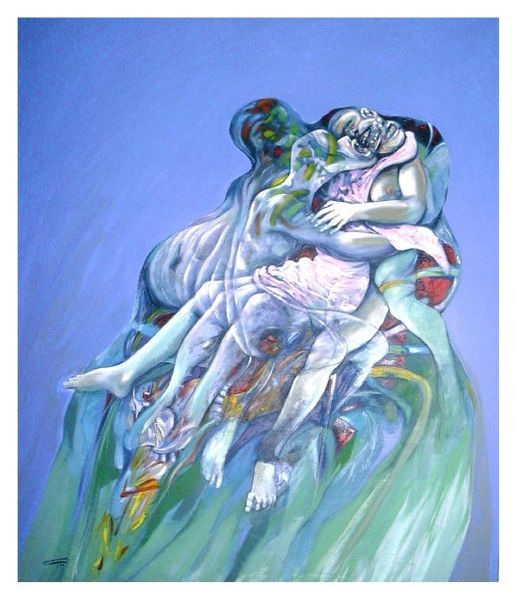



 Paul Vangelisti in Modena (photo by David Garyan)